Executive summary
Longview Commercial’s bi-annual, institutional-grade market intelligence publication — designed to give accredited investors,
whether new to private real estate funds or experienced in direct asset ownership, a clear, unvarnished view of the markets we
target for deployment.
Each edition focuses on a single metropolitan market, assessed across the dimensions that matter most: demographic
momentum, employment health, supply/demand dynamics, capital flows, and submarket selectivity. Our goal is not simply to
share data, but to translate that data into investment context relevant to a diversified multifamily portfolio.
Greenville, South Carolina serves as our seventeenth edition and the first South Carolina market in this series in the Longview
portfolio strategy. As one of the nation’s most dynamic Sunbelt metros, Greenville exemplifies both the opportunity and the
nuance that sophisticated multifamily investing demands. The following pages present our mid-2026 assessment.
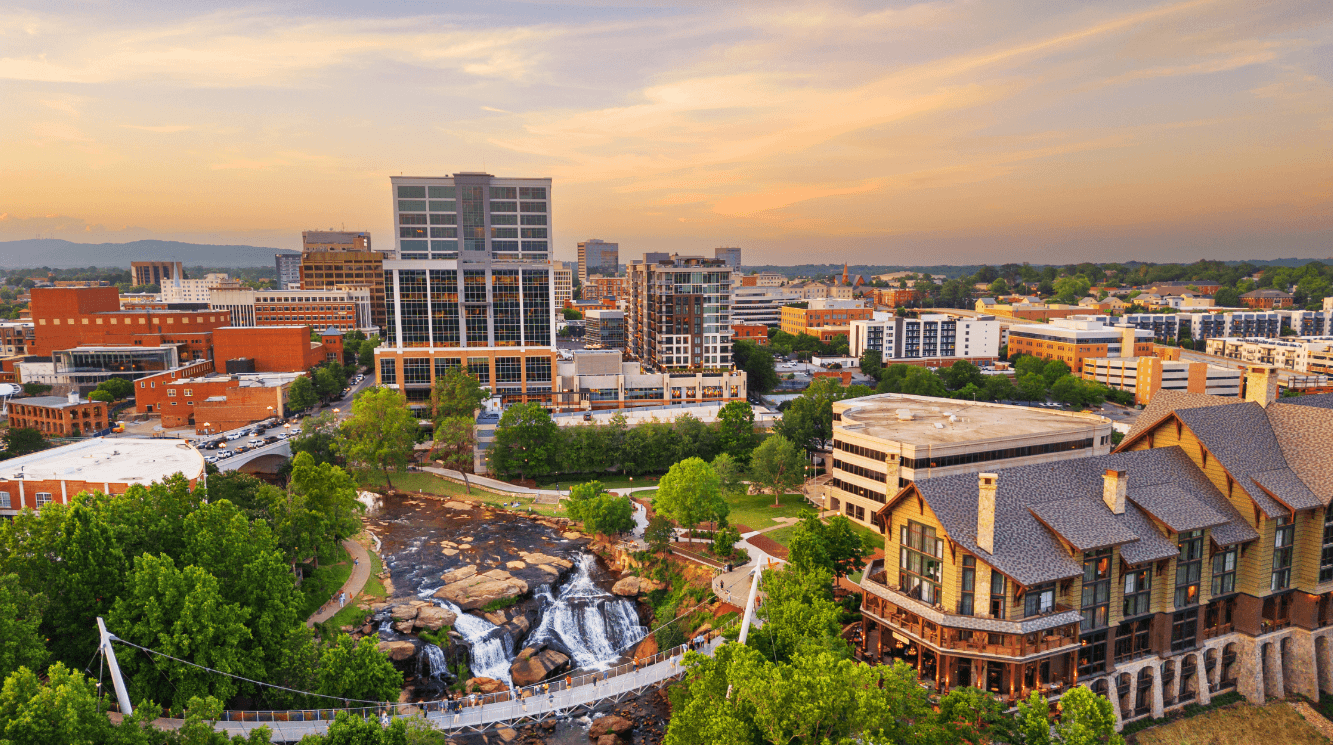
This Is What Greenville Looks Like
Longview Commercial specializes in constructing diversified institutional-quality multifamily portfolios for accredited and sophisticated investors. This report delivers an independent, data-driven assessment of the Greenville-Spartanburg multifamily sector as of mid-2026, focusing on metrics that signal market health, investment viability, and long-term positioning.
~$1,191–1,333
Average Rent per Unit
+4.2% (2026)
Rent Growth: Among the
Strongest in the Carolinas
~5.8%–11%
Overall Vacancy
$380 Million YTD
Multifamily Deal Activity
~3,825 units
Units Under Construction
Sources: Colliers International, CoStar Group. Data as of Q1–Q2 2026.
A Manufacturing-Anchored Secondary Market Outperforming on Rent Growth
Greenville-Spartanburg’s apartment inventory has expanded roughly 30% since 2015, with nearly 20,000 units delivered in the past five years, yet vacancy has remained comparatively contained — recent readings range from approximately 5.8% (CoStar sourced, near the national average) to a wider 9–11% band reflected in Colliers’ early-2025 occupancy data (which showed roughly 89% occupancy, or approximately 11% vacancy, alongside meaningful unit absorption).
Rent growth has been a genuine standout: one recent reading puts 2026 year-over-year rent growth at 4.2%, among the strongest in the Carolinas and well above the roughly 0.9% national pace, while average rents (approximately $1,191–$1,333 depending on period) remain well below the larger metros in this series. Construction activity is moderating, with active unit counts declining from 4,208 to 3,825 in the most recent period reviewed.
Current indicators point to a smaller, manufacturing-anchored market absorbing new supply in stride:
- Despite nearly 20,000 units delivered over five years, occupancy has remained resilient, with net absorption of 825–1,227 units in recent quarterly readings.
- Rent growth of approximately 4.2% year-over-year ranks among the strongest in the Carolinas, well above the national pace.
- Construction activity has moderated, declining from 4,208 to 3,825 active units in the most recent comparison available.
- Greenville County anchors South Carolina’s first metropolitan area to surpass 1 million residents on a combined-statisticalarea basis, as the state posted the nation’s fastest population growth rate in 2025.
Within the Longview portfolio, Greenville represents a genuinely different profile than the larger metros in this series: a smaller, manufacturing- and healthcare-anchored secondary market with less institutional data coverage, but rent-growth performance that has outpaced several larger, more heavily tracked Sunbelt peers.
General Metro Greenville Metrics
Economy & Demographics
Greenville County’s 2026 population is estimated at approximately 592,000, growing roughly1.6% annually and up nearly 31% since 2010. The core Greenville metropolitan statistical area reached approximately 576,000–592,000 depending on source and geographic definition, while the broader Greenville-Spartanburg-Anderson combined statistical area crossed 1 million residents in 2025– 2026 — the first South Carolina metro to do so. South Carolina was the fastest-growing state in the country in the year ending July 2025, expanding 1.5%.
Employment & Labor Force
The civilian labor force for the Greenville metropolitan area sits at roughly 515,200 people with an unemployment rate of 3.9%, outperforming both the South Carolina state average (4.4%) and the national average (4.1%). Strong regional population growth
has brought an influx of new workers into the market, keeping the local labor pool exceptionally dynamic. Available qualitative sources describe a resilient, manufacturing-anchored labor market with continued in-migration of skilled workers, particularly in
automotive and advanced manufacturing.
Job Diversity & Industry
Anchored by one of the deepest automotive and advanced-manufacturing clusters in the Southeast: BMW’s Spartanburg plant is the company’s largest manufacturing facility in the world, and Michelin North America is headquartered in Greenville. The region
also supports significant aerospace, healthcare (Prisma Health, Bon Secours St. Francis), and logistics operations, alongside major facility presences from GE and Lockheed Martin. Downtown Greenville’s nationally recognized revitalization along the Reedy River
(anchored by Falls Park) has layered a genuine urban core onto a historically manufacturing-dependent economy.
Fortune 500 Headquarters
Greenville hosts more corporate headquarters than any other region in South Carolina, though we were unable to confirm any Fortune 500 company’s global headquarters is located within Greenville proper. Michelin North America’s headquarters is based in
Greenville, though parent company Michelin Group is headquartered in France and does not appear on the U.S. Fortune 500 list. Major manufacturing and operations presences include BMW, GE, and Lockheed Martin.
Demographics & Renter Population
A renter base spanning automotive and manufacturing workers in the suburban ring (Simpsonville, Mauldin, Greer) and young professionals drawn to Downtown Greenville and the walkable Augusta Road corridor. Median household income in the city of
Greenville is approximately $71,500, with wage growth tied to manufacturing employment cited as a driver of household formation in workforce-tier communities.
Crime & Livability Trends
In the City of Greenville, South Carolina, actual raw counts of murder and non-negligent manslaughter remain low, with 3 recorded cases in 2025, down from 7 cases in 2024 and 5 in 2023. Standardized per-capita homicide rates hover around 4 to 6 per 100,000
residents, tracking close to or slightly below national averages. And according to the Greenville Police Department Crime Analysis, total overall crime in the city limits dropped by 55% over the last 25 years despite significant population growth to over 79,000 residents.
Overall, Greenville combines one of the deepest manufacturing employment anchors in the Southeast (BMW, Michelin) with genuinely strong recent rent-growth performance, set against meaningfully thinner institutional data coverage than the larger metros in this series.
Multifamily Metrics vs. National Benchmarks
Rent, Occupancy & Transaction Detail
Rent, Occupancy & Transaction Detail
Active Construction (Period)
Active Construction (Current)
Greenville’s rent growth (approximately 4.2% year-over-year in the most current reading) meaningfully outpaces the roughly 0.9% national average, even as the metro’s vacancy sits within a range that spans from near the national average to modestly above it depending on source. This combination — above-average rent growth alongside a more typical vacancy profile — distinguishes Greenville from the more binary recovery-or-oversupply narratives that characterize several larger markets in this series.
Current & Future Trends
Vacancy estimates range from near the national average to modestly elevated depending on source and period, even as the metro absorbed nearly 20,000 new units over the past five years.
Rent growth of approximately 4.2% year-over-year ranks among the strongest in the Carolinas, with luxury product in the West End and workforce
communities in Simpsonville and Mauldin both contributing.
We could not confirm current aggregate transaction volume or cap rate data specific to this market with the same confidence available for larger metros in this series.
Construction activity has moderated from 4,208 to
3,825 active units in the most recent comparison,
suggesting continued, if gradual, supply normalization.
Downtown and Greer are absorbing the most active
new construction, while suburban Class B stock
remains comparatively insulated from direct competition.
Available qualitative commentary describes robust
investor confidence and continued value growth in
stabilized assets, though this should be verified directly with local brokerage sources before underwriting.
BMW and Michelin’s multi-decade manufacturing
presence provides a demand anchor that has supported consistent absorption even through an extended construction cycle.
Continued household formation tied to manufacturing wage growth should support demand across both premium and workforce-tier segments.
Greenville’s position as an increasingly recognized secondary market may present relative-value opportunities for investors willing to accept a thinner institutional data set.
Market Projection — Five Years From Now (~2031)
Important Statistics Snapshot
Greenville Multifamily Market
Greenville-Spartanburg-Anderson combined statistical area — SC’s first metro to reach this milestone
1,000,000+
Apartmentinventory growth since 2015
~30%
Vacancy (source and period-dependent range)
~5.8%–11%
Average asking rent (source range)
~$1,191–1,333
Rent growth, year-over-year (2026) — among the strongest in the Carolinas
+4.2%
Active construction, most recent reading — down from 4,208
3,825 units
Greenville Economy Statistics
Greenville County population (2026), growing ~1.6% annually
~592,000
Job Growth: Strong (May 2026 data, among
top performers)
+2.2% YoY
Current, well-documented multi-year crime trend specific to Greenville
4-6%
Key Notes/Drivers: Manufacturing (especially automotive/advanced), healthcare, tourism, and professional services. Part of the fast-growing Upstate South Carolina corridor with robust recent job gains.
Main Companies & Market Players
Local & Regional
We did not identify a single, dominant Greenville headquartered multifamily developer comparable to the local anchors profiled in other editions of this series in our sourcing for this edition.
National Platforms
Development activity is concentrated in Downtown Greenville and Greer, with regional and national builders active across the broader Upstate South Carolina market; Greer alone accounted for 792 active units in one recent reading, the most of any submarket tracked.
Investors
Available commentary describes sustained investor confidence in the Greenville-Spartanburg market even in a higher-rate environment, with stabilized properties reportedly seeing continued value growth, though we could not verify specific transaction volume figures for this edition. Longview Commercial structures diversified portfolios to give investors access to institutional-quality multifamily without concentrating risk in any single metro’s data coverage or economic base.
Submarket Intelligence
Downtown Greenville & West End
Nationally recognized urban revitalization along the Reedy River has driven premium rent growth and attracted corporate relocations and boutique hospitality investment.
Mixed-income workforce communities where wage growth tied to manufacturing employment is driving household formation and rent growth.
Greer
The submarket with the most active new construction (792 units in one recent reading), positioned near BMW’s manufacturing campus.
West Spartanburg
Among the submarkets with the strongest recent absorption alongside Greenville/Mauldin, together accounting for the majority of a recent quarter’s net move-ins.
Data Note
Submarket views reflect qualitative positioning drawn from broker and proprietary market research as of mid-2026. Granular submarket-level rent and occupancy data were not available at point-estimate resolution for this edition and are flagged rather than estimated.
In a Nutshell
Greenville-Spartanburg in 2026 presents a genuinely different profile than the larger metros in this series: a manufacturing anchored secondary market, led by BMW’s largest global plant and Michelin North America’s headquarters, that has absorbed nearly 20,000 new apartment units over five years while still posting rent growth among the strongest in the Carolinas. Vacancy estimates vary by source, and this edition relies on thinner institutional data coverage than Longview’s larger gateway markets, but the combination of above- average rent growth, a newly crossed population milestone, and a deep manufacturing employment base makes Greenville a genuinely differentiated diversification candidate.
Longview Commercial is positioned to help accredited investors access high-quality, professionally managed multifamily exposure in this evolving market. All projections involve uncertainty; investors should conduct independent due diligence and consult offering documents.