
Nashville’s absorption nearly matched new supply over the past year — a level of balance the market hasn’t seen since before its construction surge. Of every market in this series, Nashville’s supply correction may be the closest to actually finishing.
August 2026
Mid-2026 Outlook
Longview Commercial’s bi-annual, institutional-grade market intelligence publication — designed to give accredited investors whether new to private real estate funds or experienced in direct asset ownership, a clear, unvarnished view of the markets we target for deployment.
Each edition focuses on single metropolitan market, assessed across the dimensions that matter most: demographic momentum, employment health, supply/demand dynamics, capital flows, and submarket selectivity. Our goal is not simply to share data, but to translate that data into investment context relevant to a diversified multifamily portfolio.
Nashville, Tennessee serves as our fifteenth edition and the second Tennessee market in this series in the Longview portfolio
strategy. As one of the nation’s most dynamic Sunbelt metros, Nashville exemplifies both the opportunity and the nuance that sophisticated multifamily investing demands. The following pages present our mid-2026 assessment.
Longview Commercial specializes in constructing diversified institutional-quality multifamily portfolios for accredited and
sophisticated investors. This report delivers an independent, data-driven assessment of the Nashville multifamily sector as of mid2026, focusing on metrics that signal market health, investment viability, and long-term positioning.
Sources: Yardi Matrix, Northmarq, Marcus & Millichap. Data as of Q1–Q2 2026.
Nashville absorbed approximately 8,700 units over the trailing 12 months, nearly matching new supply for the same period — a level of balance not recorded since before the metro’s 2023–2024 construction surge, which delivered more than 25,000 units at its peak. Vacancy has held roughly flat at approximately 8.5% in the most recent reading, down from approximately 11.6% at an earlier peak.
Rents, at approximately $1,643–$1,730 depending on source, have posted seven consecutive quarters of year-over-year decline, though the pace has slowed to near-flat in the most recent readings. Northmarq projects rents ending 2026 near $1,700 — essentially where they have hovered since the second half of 2022 — with a return to positive growth more likely in 2027.
Within the Longview portfolio, Nashville reads as the most cyclically advanced market in this series outside Houston: a metro that absorbed a genuinely enormous supply wave and is now approaching equilibrium, with a diversified, high-profile corporate relocation pipeline supporting the next leg of demand.
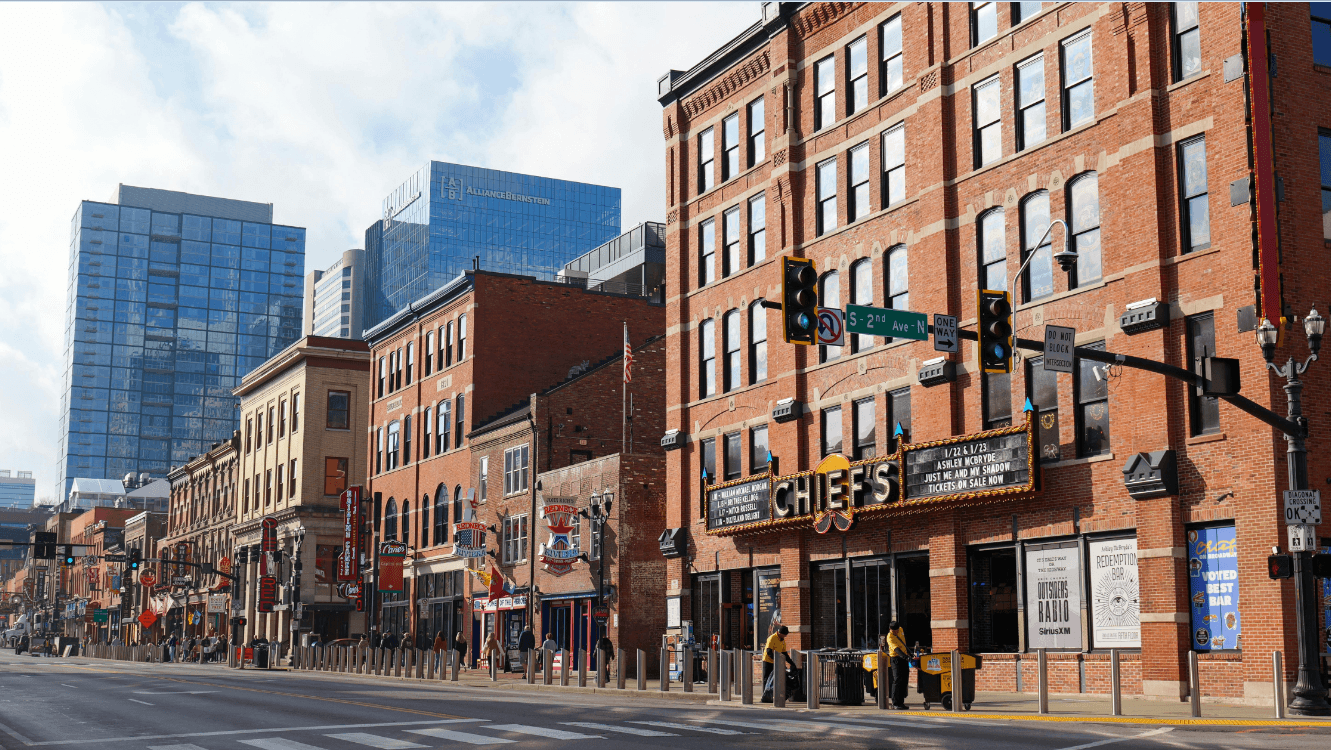
The Nashville metro area reached approximately 2.15–2.19 million residents as of 2024–2025 estimates, up roughly 6.4% since 2020, with annual growth projected in the 1.3–1.6% range through 2027 — above the national average. Nashville ranked among the top 10 major U.S. metros for young-adult population growth in the past year.
Nashville added approximately 14,000 net jobs in the 12 months ending August 2025, a 1.0% growth rate slightly outpacing the 0.8% national average, led by government and service sectors. Unemployment stood at 3.0–3.1%, well below the 4.3% national rate. Northmarq’s 2026 outlook projects approximately 24,000 additional jobs.
A diversified, service-driven economy anchored by healthcare (HCA Healthcare’s global headquarters, Vanderbilt University Medical Center’s $22+ billion annual economic contribution), automotive manufacturing (Nissan’s North American headquarters in Franklin and the Smyrna Assembly Plant, the largest single auto plant in North America by production volume), and a growing technology and corporate-relocation pipeline. Recent commitments include Amazon’s second tower at Nashville Yards, Oracle’s $1.2 billion campus (targeting ~8,500 jobs), and AllianceBernstein’s relocated HQ from New York.
The Nashville metro is home to Fortune 500 headquarters including HCA Healthcare (#61, $70.6 billion in annual revenue, Nashville proper), Dollar General (Goodlettsville), and Community Health Systems (Franklin) — all within the broader MSA, alongside large employers Bridgestone Americas, Asurion, and Tractor Supply Company.
A young, growing renter base drawn by Nashville’s relative affordability compared to coastal gateway metros, combined with a deep, diversified employment base spanning healthcare, entertainment, automotive, and a fast-growing corporate and technology sector. The metro’s continued ability to attract high-profile corporate relocations provides a tailwind for renter demand distinct from purely migration-driven growth stories.
A genuinely significant, multi-year, well-documented improvement, alongside one notable counter-trend. Nashville recorded 74 homicides in 2025, down 27.5% from 2024 and the lowest total since 2014, continuing a decline into 2026 (homicides down 25% in the first half of the year). Violent offenses fell nearly 14% in 2025 to their lowest level since 2013, and robberies and burglaries reached their lowest levels in 50+ years. The counter-trend: reported rapes rose approximately 7–20% depending on the period measured, which city officials and advocates attribute partly to increased survivor reporting rather than solely to increased incidence — a nuance worth carrying into any broader safety assessment.
Overall, Nashville combines one of the strongest recent public-safety improvement trends of any market in this series with a diversified, high-profile corporate relocation pipeline — a combination that increasingly distinguishes it from purely migration dependent Sunbelt growth stories.
Peak Under Construction (Late 2022)
~25,000+ units
Under Construction (Nov. 2025)
~16,470 units
Nashville’s supply-demand balance is arguably the most advanced of any market in this series after Houston: absorption has nearly caught up with new supply, and the construction pipeline has fallen by roughly a quarter from its peak. Where several markets in this series are still waiting for a construction pullback to show up in the data, Nashville’s improvement is already
visible in both occupancy and decelerating rent declines.
CURRENT (2026)
Vacancy has improved from an earlier peak of ~11.6% to roughly 8.5% in the most recent reading, with absorption nearly matching new supply for the first time since before the construction surge.
Downtown Nashville remains the metro’s clearest exception, with vacancy still elevated at 9.4% even as Class A vacancy there recently fell below Class B.
Investment activity has slowed, with transaction counts down 13% year over-year and average pricing down for a third consecutive year.
5-YEAR OUTLOOK ( 2031)
With the pipeline down about 25% from its late-2022 peak and permits down more than 50%, 2026 deliveries are set to fall for a third consecutive year, supporting continued vacancy improvement.
Suburban counties including Sumner County are seeing increased development tied to corporate investment, spreading both supply and demand beyond the urban core.
As borrowing costs ease, 2026 is expected to bring more active capital deployment, focused on asset quality and operational upside.
10-YEAR OUTLOOK
Nashville’s diversified healthcare, automotive, and fast-growing corporate/technology base —
reinforced by recent relocations — provides a demand foundation for the next phase of the cycle.
Cool Springs and Williamson County, anchored by Nissan’s headquarters and other Class A office demand, represent a structurally tighter submarket than the downtown core.
Compression in average deal size and pricing may present relative-value entry points ahead of the anticipated 2027 rent-growth recovery.
Decline in units under construction from the late-2022 peak of 25,000+
~25%
Trailing 12-month absorption, nearly matching new supply
8,700 units
Vacancy—earlierpeakvs. most recent reading
~8.5%–11.6%
Average asking rent (source range)
~$1,643–1,730
Average price per unit, 2025 — down for a third consecutive year
~$185,358
Average caprate; institutional Class A trading 4–5%
~5.5%
Metro population, up~6.4% since 2020
~2.15–2.19M
Unemployment Rate: Low
~3% range
Job Growth: Positive/moderate (slightly outpacing the 0.8% national average)
1.0%
Homicide decline, 2025 vs. 2024 — lowest total since 2014
−27.5%
Key Notes/Drivers: Healthcare, music/entertainment/tourism, logistics, professional services, and corporate HQs. Consistent growth and in-migration.
Matthews Real Estate Investment Services and
Carter Haston Real Estate Services are both headquartered in Nashville, reflecting the metro’s deep bench of locally rooted multifamily investment and services platforms.
National platforms remain highly active in Nashville following the 2022–2024 construction boom, alongside a broad base of regional developers that helped deliver more than 25,000 units at the market’s peak construction pace.
Investment activity has slowed from 2021 peak levels, with transaction counts down 13% year-over-year in 2025 and average pricing down for a third consecutive year. Longview Commercial structures diversified portfolios to give investors access to institutional-quality multifamily without concentrating risk in any single metro’s supply cycle or industry base.
Submarket
Profile & Theme
Longview View
Cool Springs & Williamson County
Anchored by Nissan’s North American headquarters and other Class A office demand, supporting some of the metro’s tightest fundamentals outside the urban core.
Favorable
Sumner County (Gallatin) & Suburban Growth Corridors
Benefiting from corporate investment such as Gap Inc.’s $58 million facility, driving increased residential development in previously lighter-supply suburbs.
Selective
Downtown Nashville
The metro’s highest-vacancy submarket at 9.4%, though Class A vacancy recently fell below Class B here — an early positive signal even as deliveries continue to outpace absorption.
Selective
Southeast Nashville
Along with Downtown, one of the two submarkets that saw the highest concession usage during the recent supply surge.
Cautious
Submarket views reflect qualitative positioning drawn from broker and proprietary market research as of mid-2026. Granular submarket-level rent and occupancy data were not available at point-estimate resolution for this edition and are flagged rather than estimated.
Nashville in 2026 presents the most balanced supply-demand picture of any market in this series outside Houston: absorption has nearly caught up with new supply, and the construction pipeline has fallen roughly 25% from its late-2022 peak. Rents remain roughly flat after seven consecutive quarters of decline, and average pricing has fallen for a third straight year, but a diversified corporate relocation pipeline and one of the most significant public-safety improvements in this series support a constructive multi-year view. Within a diversified allocation, Nashville reads as a later-cycle, more resolved complement to the earlier-stage corrections still playing out in Austin, San Antonio, and Memphis.
Longview Commercial is positioned to help accredited investors access high-quality, professionally managed multifamily exposure in this evolving market. All projections involve uncertainty; investors should conduct independent due diligence and consult offering documents.
Website: www.longviewcommercial.com