
Orlando’s vacancy has already pulled back nearly 150 basis points from its late-2024 peak, transaction volume is at its highest level since 2022, and per-unit pricing sits roughly 25% below the 2022 top. The direction of travel here matters more than the headline number.
August 2026
Mid-2026 Outlook
Longview Commercial’s bi-annual, institutional-grade market intelligence publication — designed to give accredited investors whether new to private real estate funds or experienced in direct asset ownership, a clear, unvarnished view of the markets we target for deployment.
Each edition focuses on single metropolitan market, assessed across the dimensions that matter most: demographic momentum, employment health, supply/demand dynamics, capital flows, and submarket selectivity. Our goal is not simply to share data, but to translate that data into investment context relevant to a diversified multifamily portfolio.
Orlando, Florida serves as our ninth edition and the third Florida market in this series in the Longview portfolio strategy. As one of the nation’s most dynamic Sunbelt metros, Orlando exemplifies both the opportunity and the nuance that sophisticated multifamily investing demands. The following pages present our mid-2026 assessment.
Longview Commercial specializes in constructing diversified institutional-quality multifamily portfolios for accredited and sophisticated investors. This report delivers an independent, data-driven assessment of the Orlando multifamily sector as of mid2026, focusing on metrics that signal market health, investment viability, and longterm positioning.
Sources: Yardi Matrix, CoStar Group, Northmarq, Cushman & Wakefield. Data as of Q1–Q2 2026.
Orlando’s apartment vacancy peaked at approximately 11% in late 2024 — among the highest readings of any Florida metro in this series — and has since pulled back to approximately 9.5–10% as of Q1 2026. Stabilized-property occupancy, measured
separately by Yardi Matrix, held up better throughout, settling at 94.5% as of September 2025.
The construction pipeline has thinned meaningfully: units under construction fell to approximately 11,367 by the end of 2025, and multifamily starts in 2024 (roughly 5,000) ran well below the 10-year historical average of about 9,400. Transaction activity has responded, with 2025 multifamily investment volume up 56% year-over-year to its highest level since 2022, aided by per-unit pricing running roughly 25% below the 2022 peak.
Within the Longview portfolio, Orlando pairs closely with Tampa: both Florida metros absorbed an unusually large, compressed supply wave and are now working through the recovery on a similar timeline, with tourism-driven demand providing a distinct structural anchor neither Texas nor Miami directly replicates.
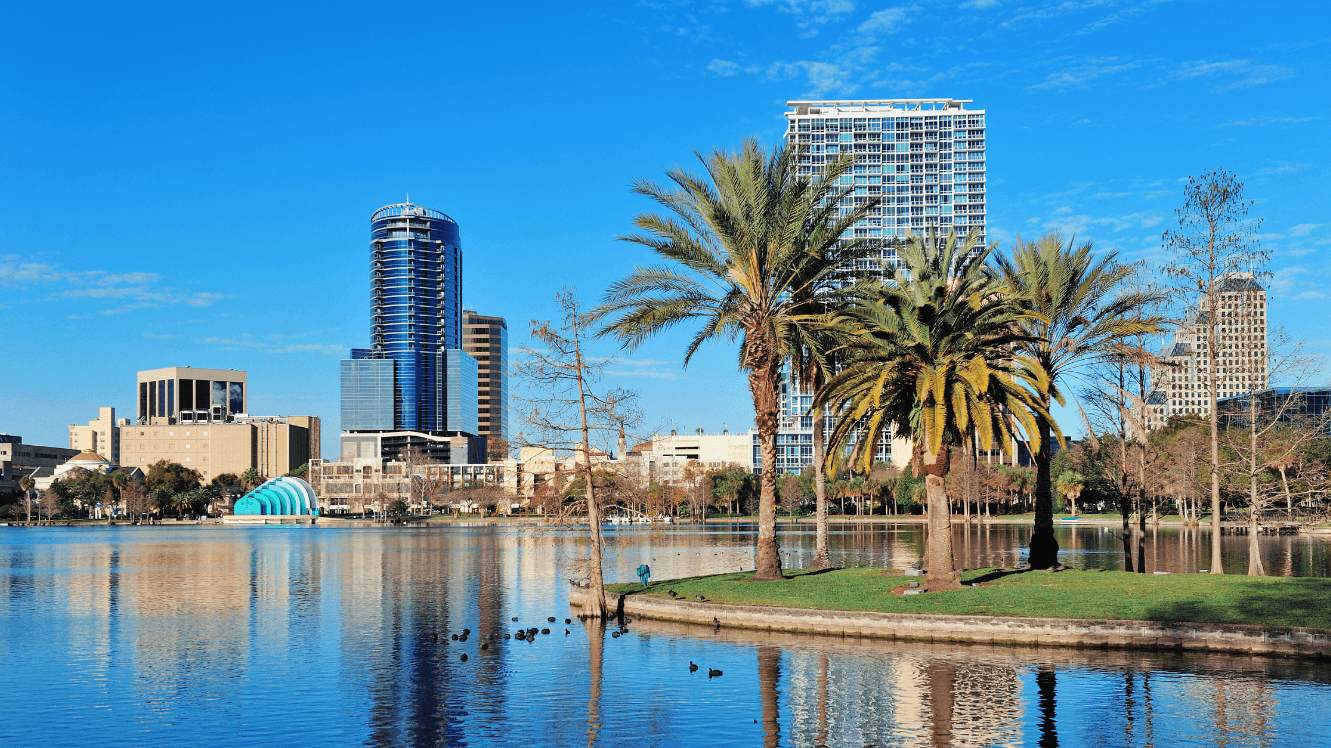
The Orlando-Kissimmee-Sanford metro added approximately 37,690 to 38,000 new residents in the year ending July 2025 — the fastest-growing metro in Florida by total population increase and the sixth-fastest among large U.S. regions. Metro population expanded approximately 12.7% over the five years ending 2024, one of the fastest rates among major U.S. markets, though the pace of growth is showing early signs of moderation consistent with the broader Sunbelt migration slowdown.
Orlando employment grew approximately 1.7% year-over-year through August 2025 — more than double the 0.8% national rate — adding roughly 19,000 net jobs over the trailing 12 months, with leisure and hospitality contributing 5,800 positions. The Orange County Convention Center’s $560 million Grand Concourse expansion moved into construction in 2026, a meaningful near-term capital investment signal for the tourism sector specifically.
Tourism and hospitality anchor the economy — Orlando is the fourth-most-visited U.S. city, home to Walt Disney World and Universal Orlando, with Orlando International Airport ranking among the busiest in the country. Less widely known: Orlando hosts the nation’s modeling, simulation, and training (MS&T) industry cluster, centered on the Central Florida Research Park adjacent to the University of Central Florida, with more than 120 companies and 8,500+ employees, alongside defense and engineering operations from Lockheed Martin and other major contractors.
Orlando’s Fortune 500 presence is thinner than most other metros in this series; the region’s economic weight instead comes from its position as a global tourism and entertainment capital (Disney, Universal, and their extensive supplier and hospitality ecosystems) and its defense/simulation-industry cluster, rather than from traditional corporate headquarters concentration.
Orlando’s median household income (approximately $72,300 for the city proper) and median age (35.1) sit in a similar range to Tampa’s. The renter base skews toward a large hospitality and tourism-sector workforce alongside a growing technology and defense-contractor presence tied to the Central Florida Research Park.
A genuinely mixed picture. City-level crime-rating services have cited Orlando’s violent crime rate as running well above both state and national averages, concentrated disproportionately in specific tourist-corridor areas with high foot traffic. At the same time, most trackers describe crime as trending downward over recent years. This is a market where neighborhood-level, not metro level, crime due diligence is particularly important.
Overall, Orlando combines the strongest population-growth rate of any Florida metro in this series with a genuinely tourism dependent economic base — a structural demand driver with real appeal, balanced by seasonality and wage-level considerations distinct from the more corporate-anchored metros in this series.
2025 Transaction Volume (YoY)
+56%
Price/Unit vs. 2022 Peak
−25%
Orlando’s trajectory mirrors Tampa’s closely: both metros absorbed an outsized share of the 2023–2024 Florida supply wave and are now working through recovery on parallel timelines. Orlando’s differentiator is its tourism-anchored demand base, which provides durable, if more seasonally variable, renter demand than the more purely migration-dependent growth story in some peer Sunbelt metros.
CURRENT (2026)
Vacancy peaked around 11% in late 2024 and has pulled back to approximately 9.5–10%, driven by improving absorption and a thinning construction pipeline.
Submarket performance is diverging clearly: the CBD and Northwest Orlando saw some of 2025’s largest vacancy
declines and face limited future supply pressure, while Ocoee-Winter Garden Clermont, South Orange County, and Kissimmee- Osceola County continue to face notable supply pressure
Transaction activity accelerated materially in 2025, reaching its highest level since 2022, supported by pricing prior peak
5-YEAR OUTLOOK ( 2031)
With starts well below the historical average and the pipeline at its lowest level since at least 2020, vacancy is expected to continue tightening through 2026 and into 2027.
As deliveries taper further, the gap between favorably positioned and supply-heavy submarkets should persist through at least 2026.
Continued interest-rate easing could support further cap rate compression and additional transaction volume growth in 2026.
10-YEAR OUTLOOK
Orlando’s tourism, defense/simulation, and
growing technology sectors provide a demand base that should support continued absorption once the current supply overhang clears.
Investors should expect meaningfully different outcomes by submarket even as metro-wide fundamentals improve on average.
Orlando’s combination of population growth, a diversifying economy, and reset pricing supports a constructive multi-year entry case for patient capital.
Vacancy, late-2024 peak vs. Q1 2026 (allproperty basis)
~11% → ~9.5–10%
Under construction, end of 2025 — down substantially from the 2024 peak
~11,367 units
Stabilized occupancy (Yardi Matrix, September 2025)
94.5%
Average asking rent (source range)
~$1,640–1,763
2025 transaction volume growth, year- overyear—highest since 2022
+56%
Cap rates, current range across sources
5.0–6.5%
Medianprice per unit vs. the 2022 peak
−25%
Metro population — 2nd-fastest net in- migration nationally in 2025
~2.7M+
Unemployment Rate
~4.4–4.5%
Job Growth (e.g., +16k–18k jobs in recent over-the-year periods in some reports)
Notable gains
Homicide rate a historic low representing a drop from 2024
58%
Key Notes/Drivers: Tourism/leisure/hospitality (theme parks), healthcare, professional services, and logistics. Strong recent job additions tied to visitor economy and in-migration.
Atlantic Housing Partners, headquartered in Orlando, owns approximately 3,400 apartments across 18 local properties with a focus on affordable and workforce housing, while Real Estate Inverlad (REID), also Orlando-based, has developed more than $1 billion across multifamily and mixed-use
projects in the metro.
National platforms with a substantial Orlando presence include Camden Property Trust (approximately 3,000 units locally, part of its 55,000+ unit national portfolio) and The Bainbridge Companies, alongside active regional builders such as Thompson Thrift and Skorman Development.
Investment activity accelerated materially through 2025, with transaction velocity and volume reaching the highest levels since 2022 as pricing reset roughly 25% below the prior peak. Longview Commercial structures diversified portfolios to give investors access to institutional-quality multifamily without concentrating risk in any single metro’s recovery timeline.
Submarket
Profile & Theme
Longview View
CBD & Northwest Orlando
Saw some of 2025’s largest vacancy declines and face limited future supply pressure, positioning these submarkets as the metro’s clearest near-term outperformers.
Favorable
East Orlando & East Outlying
Cited among the metro’s strongest recent rent-growth performers in at least one forecast, reflecting comparatively lighter supply pressure than the southwestern corridors.
Selective
Kissimmee-Osceola County
Carries the most units still under construction of any Orlando submarket and will likely be the last to fully stabilize.
Cautious
Ocoee-Winter Garden- Clermont & South Orange County
Continuing to face notable supply pressure in the months ahead, per multiple sources tracking the metro’s submarket-level delivery schedule.
Cautious
Submarket views reflect qualitative positioning drawn from broker and proprietary market research as of mid-2026. Granular submarket-level rent and occupancy data were not available at point-estimate resolution for this edition and are flagged rather than estimated.
Orlando in 2026 is a market that has moved past its cyclical peak but is still working through the tail of an outsized 2023–2024 supply wave. Vacancy has compressed meaningfully from its late-2024 high, transaction activity is at its strongest pace since 2022, and pricing has reset to a more attractive entry basis. Orlando’s tourism and defense/simulation-industry base provides demand drivers with no direct parallel elsewhere in this series, balanced against real supply overhang in specific submarkets, seasonality considerations, and the same Florida insurance and hurricane exposure carried by Miami and Tampa. Within adiversified Sunbelt allocation, Orlando pairs closely with Tampa as a Florida recovery-stage opportunity.
Longview Commercial is positioned to help accredited investors access high-quality, professionally managed multifamily exposure in this evolving market. All projections involve uncertainty; investors should conduct independent due diligence and consult offering documents.
Website: www.longviewcommercial.com